

????????????????????????
Whether it's medicine or another field of study that involves theories and methods of practice which have been established for many years, it is often difficult for people to accept a new way of thinking and a different way of doing things. This certainly was the case as Hahnemann introduced homeopathy and the *law of similars or like cures like.
Hahnemann's ideas were met with a mixture of curiosity and disdain by his contemporaries. As the interest and use of homeopathy grew, the push back and ridicule of it also increased.
Hahnemann challenged those who questioned the validity of homeopathic remedies, to simply go through the steps of testing it as he had done.
Dr. Constantine Hering was one such German doctor that took on Hahnemann's challenge. During the years of 1821 to 1822, Hering worked on a book meant to criticize and discredit homeopathy with the hope of being able to stop the practice of it altogether.
While preparing material for his book, Hering came across the challenge:
?The doctrine appeals not only chiefly, but solely to the verdict of experience, ?repeat the experiments?, repeat them carefully and accurately and you will find the doctrine confirmed at every step? and it does what no medical doctrine, no system of physic, no so-called therapeutics ever did or could do, it insists upon being judged by the result.? 1
???????????????????????????????
Hering took those essential steps and to his surprise instead of 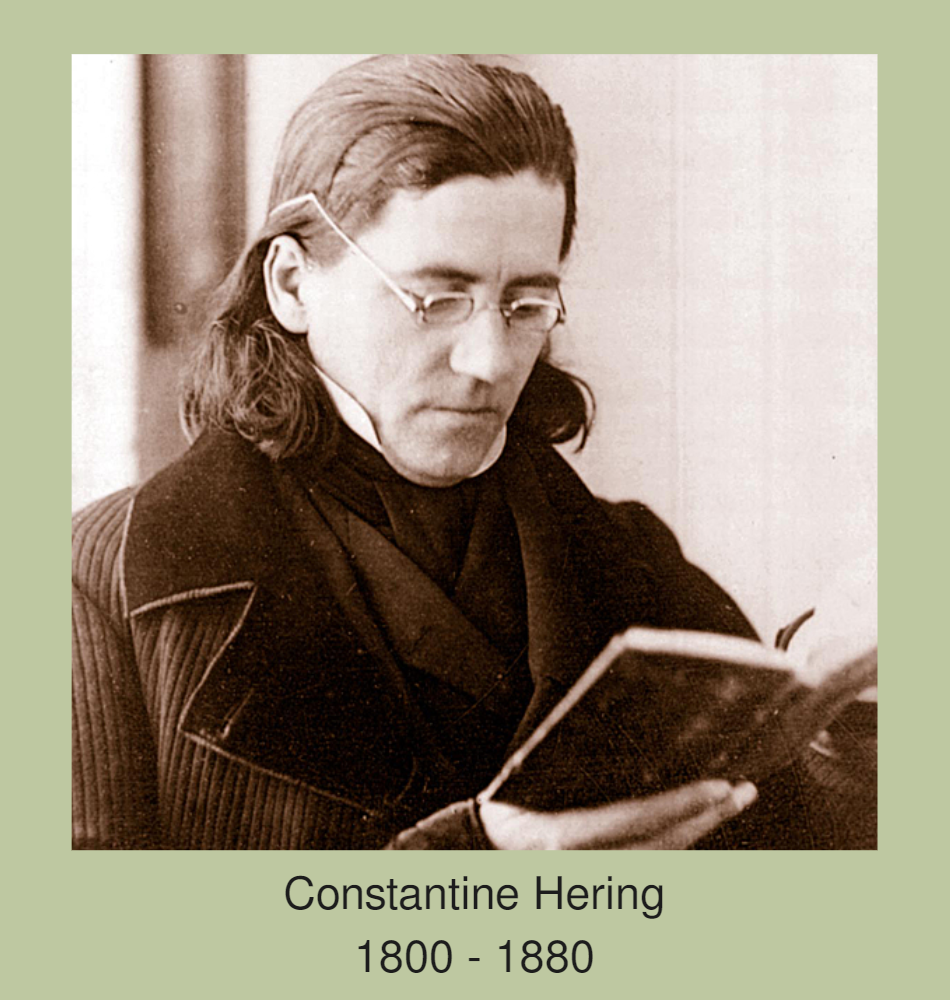 disproving homeopathy he began to see the positive and healing effects of the medicine. The end result of course was that he did not finish the book against homeopathy.
In fact, Dr. Constantine Hering became a staunch advocate of homeopathy and is credited as being the father of homeopathy in America.
After leaving Germany and then studying zoology and botany in South America for 7 years, Hering immigrated to the United States in 1833. He then helped found the Hahnemannian Society of Philadelphia in 1835.
Hering was also one of the founding doctors of the North American Academy of Homeopathic Medicine in Allentown, Pennsylvania, the first homeopathic medical school in the United States.2
The proving of 72 remedies was another major contribution of Hering?s.3 Homeopathy students can learn much by studying the life, observations and writings of Dr. Constantine Hering.
[1] https://www.homeobook.com/life-and-works-of-dr-constantine-herring/
[3] https://www.homeobook.com/life-and-works-of-dr-constantine-herring/
*The Law of Similars asserts that any substance that can cause symptoms when given to a healthy person can help to heal someone that is experiencing similar symptoms when that substance is given in a highly diluted form.